Why Your Intex Pump Is Losing Flow and How to Find Out
If your intex saltwater pump low flow problem has crept in over the last few weeks, you’re not imagining it. The water coming back into the pool feels weaker. The skimmer basket seems to pull less, and the pressure gauge on top of the filter may be sitting lower than it used to. Low pressure in an above-ground system usually points to a restriction somewhere between the skimmer and the return jet. Catching it early matters, because a pump that works hard against a blockage runs hotter and wears its seals faster. This guide walks through the checks you can do yourself before you pick up the phone.
Here’s the short version. Most low-flow complaints trace back to a clogged basket, a dirty filter, a trapped impeller, a partly closed valve. Or a gauge that’s lying to you. Each of these is easy to test, and none of them requires special tools. Work through the list in order, and you’ll usually find the culprit within an hour.
Five Checks That Pinpoint a Restricted Pump

Start with the simplest possibility and work toward the less obvious ones. Turn the pump off and let the system settle before you open anything. Never open a pressurized filter or lid while the pump is running. Keep the power switched off at the breaker when you work on wiring or the motor housing. The steps below follow the order most technicians use when they are trying to rule things out quickly.
1. Inspect the pump basket for debris
- Switch off the pump and the timer at the control box so nothing can start while you work. Wait a minute for the pressure in the housing to drop. Then unscrew the strainer lid on the pump, which is usually a clear or black cap with a gasket around its rim.
- Lift out the strainer basket and look at it closely. Leaves, twigs, bugs, hair, and fine grit often collect here, and a basket packed with debris can cut flow dramatically. Shake out loose material and rinse the basket under a garden hose until the mesh looks open.
- Check the gasket on the lid as you put it back. A flattened or cracked o-ring lets air into the suction line. Air is one of the most common reasons a pump looks like it has lost prime. Lightly lubricate the gasket with pool-safe silicone grease if it looks dry.
- Refill the pump housing with water before you close the lid. Most pumps need to be primed before they will move water properly. A dry strainer chamber can make the pump sound loud and push very little. Pour water through the opening until the housing is full.
- Restart the system and watch the pressure gauge for a few minutes. If the basket was the problem, the needle should climb noticeably and the return flow should strengthen. If nothing changes, move on to the filter itself.
2. Check the filter media for clogs
The filter does most of the work of trapping fine particles, so it is the next place to look. A sand filter’s media bed can become packed with fine debris and form channels or hard clumps, which keeps water from passing evenly. Cartridge and DE filters clog differently, with the element or grids coated over time. In all three cases, a rising gauge reading after backwashing or cleaning is a strong hint that the media is the bottleneck.
Run the system and note the pressure reading on the gauge with the pump on. Then compare it to the clean reading you recorded when the pool was new or after your last full cleaning. A gap of around 8 to 10 psi above the clean baseline is a common rule of thumb. That tells you it’s time to clean. The exact number depends on your model. Backwash a sand filter until the sight glass runs clear, or pull and hose down a cartridge element. If the problem persists after a thorough cleaning, the media may be worn out, and that is a replacement conversation rather than a maintenance task. The Wikipedia overview of pool filters explains how each filter type traps debris and why media condition affects flow.
3. Examine the impeller for blockages
The impeller is the spinning vane wheel inside the pump housing, and it’s the part that actually pushes water through the system. Hair, small stones, and string can wrap around its shaft or jam between the vanes. When this happens, the motor may hum or run warmer than usual while pushing very little water. Some pumps also let a little air enter when the impeller is partly blocked, which makes flow sputter.
To check it, shut the power off completely at the breaker and make sure nothing can restart the pump. Remove the strainer housing and the front cover if your model allows it, then look for wound-up hair or grit around the impeller shaft. Turn the impeller by hand to feel for drag or a grinding catch. Do not force it, and if the motor shaft is seized or the housing has cracks, stop and call a technician. A seized impeller often means a motor or bearing failure is coming, which is more than a simple cleaning job.
4. Verify valve positions and hose connections
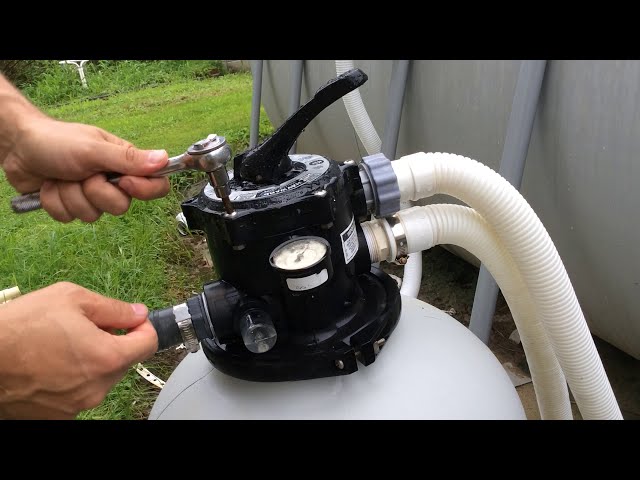
Plenty of low-flow complaints come from a valve that is set one notch wrong. Multiport valves on sand and DE filters have a specific position for each function, such as filter, backwash, rinse, and waste. If the handle is between positions, water can bypass the filter or take a partial path that reduces pressure at the return. Check that the handle clicks firmly into its detent and that the arrow points where your manual says it should for normal filtering.
Next, look at the hoses and fittings between the pump, filter, and returns. A kinked hose, a loose clamp, or a cracked union can pull air into the line or leak water before it reaches the filter. Tighten clamps by hand first, and inspect the unions for hairline cracks. Also check that the skimmer weir door moves freely, because a stuck door or a blocked skimmer throat will starve the pump at the intake. The next step is a formal check of the gauge, so keep your notes handy.
5. Test the pressure gauge against expected readings
A gauge can read wrong for years without anyone noticing. If the needle is stuck, bent, or sitting at zero when the system is running, the reading means nothing. To test it, run the pump, wait for the needle to settle. Then look at whether the number moves when you backwash or open a return. A healthy gauge reacts within a few seconds to changes in flow. If it doesn’t, replace it, since most gauges cost only a few dollars at a pool supply store.
Compare the reading to the clean baseline you wrote down earlier. A big drop with the same pump speed points to a restriction on the suction side, such as a basket or skimmer problem. A high reading with weak return flow often means the filter or return lines are blocked. Keep a simple log with the date, the reading, and what you changed. Over a few weeks, that log will show you whether the fix worked and help you spot slow trends before they become a failure.
Keeping Flow Strong Through the Season
Seasonal habits do more for flow than most repairs. Clean the skimmer basket every few days during heavy leaf drop, and check the filter pressure after every big storm. Keep the water balanced, because scale and debris build up faster in water that’s out of range, which shortens the time between cleanings for your intex saltwater pump low flow. Consider running the pump a bit longer in hot months, since it helps keep the media from packing down between cycles. These habits are simple, and they prevent most of the low-flow problems described above.
Wrapping Up the Flow Check and Keeping Records
Work through the five checks in order to fix intex saltwater pump low flow: the basket, the filter media, the impeller, the valves and hoses, and finally the gauge. Most low-flow problems turn up in the first two steps, and you can finish the whole sequence in an afternoon. Record the pressure reading after each change so you know which fix made the difference. If the impeller is seized, the motor runs hot, or the problem returns after a full cleaning, stop. Call a qualified pool technician before the motor or seals fail. A few minutes of careful checking now can save you a costly repair later.
You May Also Like
- Saltwater Versus Sand Pump Performance Under Low Pressure Conditions
- Circulation Drops in Sand Based Filters Require Specific Checks
- Four Factors That Reduce Pressure in Pool Filters
- Sand Filters Compared with DE Filters on Leak and Flow Problems
- Why Diatomaceous Earth Filters Develop Cracks in the Manifold